Contents
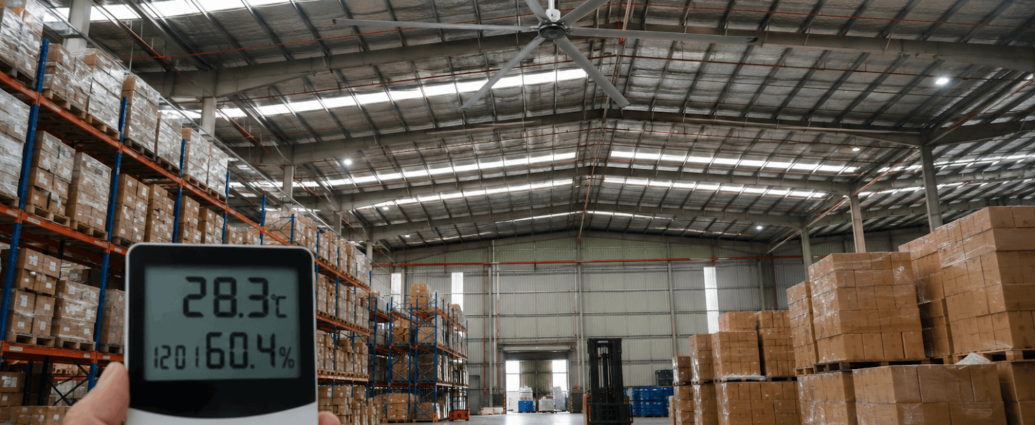
Humidity is among the major factors that make warehouses unfavorable for workers and inventory. Moisture may spoil products, facilitate mold growth, create condensation in machines, and cause discomfort at the workplace. This usually makes warehouse owners ask Can HVLS Fans Reduce Humidity in Warehouses?
The answer is yes, but in an indirect way. High Volume Low Speed (HVLS) fans cannot dry air since they do not perform such functions as dehumidifiers. However, they promote better air circulation and prevent any stagnant areas of air, thus helping to tackle problems connected with humidity.
How HVLS Fans Work
HVLS (High Volume Low Speed) fans are huge ceiling fans used in industrial spaces. They have sizes of about 8 to 24 feet in diameter. Unlike ordinary fans operating at high speed and working only within a certain radius, HVLS fans circulate enormous volumes of air at low speeds over the entire warehouse surface.
Their key role is to generate airflow covering all the area of a facility evenly. Thus, ventilation becomes more efficient, there are no hot or cold spots, and people feel comfortable during work.
Do HVLS Fans Reduce Humidity?
HVLS fans cannot decrease the humidity level since the fans do not take water vapor out of the air. But they mitigate the problem of high humidity through increased air movement.
How do they do that?
- Eliminate accumulation of wet air in the premises.
- Prevent condensation on the walls, ceiling, windows, and machines.
- Increase evaporation of moisture from the surface.
- Complement existing ventilation and dehumidification systems.
- Provide improved conditions for storing products and working employees.
The continuous air movement ensures even distribution of moisture across the space and prevents its accumulation in certain areas where mold, mildew, or corrosion may appear.
HVLS Fan Benefits for Warehouse Humidity Control
Minimization of Condensation
Condensation happens when moist air meets cooler objects. In warehouses with poor air circulation, condensation appears on the roof, equipment, and shelves.
The constant mixing of air in the premises by HVLS fans minimizes condensation formation.
Air Circulation Improvement
One of the major reasons for humidity-related problems is stale air. The large warehouse facilities have corners, high shelves, and storage areas where there is little or no movement of air.
HVLS fans provide a gentle yet powerful breeze which ensures proper movement of air in these areas and reduces the accumulation of moisture.
Protection of Stock
A lot of stock items kept in the warehouses are sensitive to moisture. These include:
- Electronics
- Paper products
- Medicines
- Food packaging materials
- Textiles
- Wooden furniture
The use of HVLS fans ensures that these items do not get affected because of the formation of moisture on them.
Increase Comfort of Employees
Humid conditions make people feel extremely hot. HVLS fans increase airflow and make it possible for sweat to evaporate quickly from the body, making the temperatures several degrees cooler. But in reality, the temperature remains unchanged.
HVAC Efficiency
HVLS fans complement HVAC systems by ensuring even distribution of conditioned air within the warehouse facility. In winter, they help in destratification of heated air.
Still Require a Dehumidifier?
Yes, particularly when you live in humid places.
Though HVLS fans enhance airflow, they do not have the capability of extracting moisture from the air. If your warehouse suffers from high humidity levels or you store moisture-sensitive products there, using HVLS fans along with industrial dehumidifiers will prove effective.
Climate Control System
A climate control system for a warehouse can include:
- HVLS industrial ceiling fans
- Mechanical ventilation
- Industrial dehumidifiers
- Insulation
- Effective HVAC system
This combination of systems provides better humidity control while increasing energy efficiency.
HVLS Fans for Industries
HVLS fans are commonly used in industries where airflow and reduction of humidity problems are required. These industries are:
- Distribution centers
- Manufacturing units
- Food processing facilities
- Cold storage facilities
- Automotive plants
- Logistics centers
- Agricultural storage facilities
- Retail warehousing facilities
The capability of covering thousands of square feet with a single fan makes HVLS fans a very cost-effective air movement solution.
Conclusion
Well, do HVLS fans dehumidify warehouses? No. HVLS fans don’t actually remove moisture from the air, just as any dehumidifiers do. But they contribute immensely to solving humidity-related problems by ensuring good air circulation, eliminating condensation, avoiding stagnant air, and providing warehouse ventilation. Combined with an adequate ventilation and humidity control system, they create a safe, healthy, and energy-efficient environment in the warehouse.
If you are in search of efficient industrial air circulation systems for your warehouse, factories, logistics facilities, or other commercial buildings, Bigvent Fans is here to provide top-quality HVLS fans for your premises. Discover Bigvent Fans’ energy-saving HVLS fan solutions for improved airflow, higher comfort, and productivity in your workplace.
FAQs
Do HVLS fans remove moisture from the air?
No. HVLS fans don’t remove moisture from the air, as a dehumidifier would. They increase airflow, and thus help to eliminate moisture and condensation in the warehouse.
Can HVLS fans stop mold development?
Yes, they are able to do so since HVLS fans create an environment with no stagnant air and low surface moisture levels. However, if the level of humidity is extremely high, dehumidification will be needed.
Are HVLS fans good for humid regions?
Certainly. HVLS fans work perfectly fine in humid conditions as they increase airflow and workers’ comfort. In order to achieve the best humidity regulation results, HVLS fans are often combined with ventilation or dehumidification systems.
Will HVLS fans reduce heating and cooling costs in warehouses?
Yes, they are likely to help as they make HVAC systems more efficient thanks to even distribution of air in a building.
What is the difference between HVLS fans and dehumidifiers?
HVLS fans help distribute the air in order to eliminate condensation, while dehumidifiers take out moisture from the air. Using both systems will ensure the best results in terms of humidity control.