Contents
- What Is the Droven.io AI Career Roadmap?
- Why Are More People Considering Careers in Artificial Intelligence?
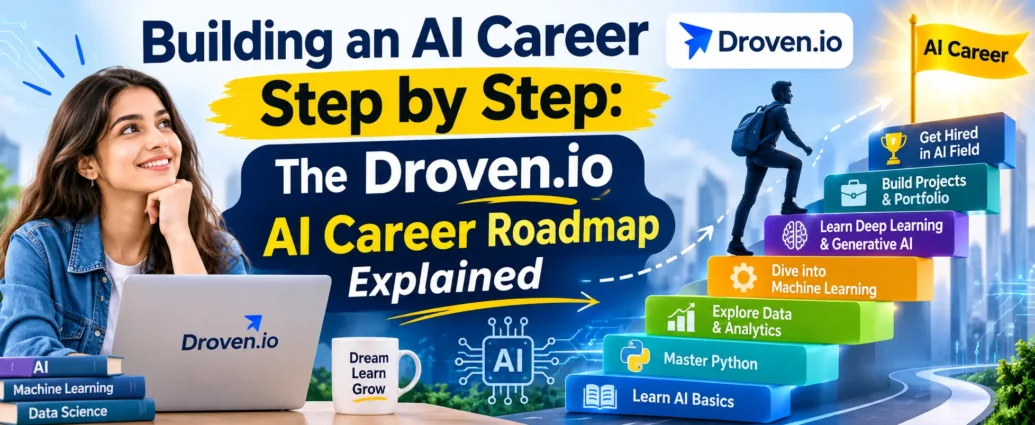
- Droven.io AI Career Roadmap: 8 Stages to Build Your Skills
- Stage 1: Understand Artificial Intelligence Fundamentals
- Stage 2: Learn Python and Essential Programming Skills
- Stage 3: Develop Mathematics, Statistics, and Data Knowledge
- Stage 4: Understand Machine Learning
- Stage 5: Explore Deep Learning and Neural Networks
- Stage 6: Learn Generative AI and Large Language Models
- Stage 7: Build Practical AI Projects and a Portfolio
- Stage 8: Prepare for AI Jobs and Professional Opportunities
- Which AI Career Path Should You Choose?
- How Long Does It Take to Build an AI Career?
- Common Mistakes to Avoid When Following an AI Career Roadmap
- Responsible AI Knowledge Is Also Important
- A Simple Weekly Study Plan for AI Beginners
- Frequently Asked Questions (FAQs)
- 1. What is the Droven.io AI Career Roadmap?
- 2. Can a beginner start an AI career without programming experience?
- 3. Which programming language is best for an AI career?
- 4. Do I need a computer science degree to work in AI?
- 5. How long does it take to learn AI from scratch?
- 6. Is machine learning necessary for every AI job?
- 7. What projects should beginners include in an AI portfolio?
- 8. Are AI certifications enough to get a job?
- 9. What is the difference between an AI engineer and a machine learning engineer?
- 10. Which AI skills should professionals learn in 2026?
- Final Thoughts
Artificial intelligence is changing how companies develop products, manage information, automate everyday tasks, and make business decisions. As more industries adopt AI-powered systems, professionals with the right combination of technical knowledge and practical experience are finding new opportunities across the technology sector.
However, entering this field is not as simple as learning a few AI tools or completing an online course. Someone interested in becoming an AI engineer may need a different set of skills from someone pursuing data science, AI product management, or generative AI development. Without a clear direction, beginners can spend months jumping between programming tutorials, machine learning courses, and new AI applications without developing the experience employers actually look for.
This is where the Droven.io AI Career Roadmap becomes an interesting search topic for people exploring a career in artificial intelligence. Instead of treating AI as one specific profession, a useful career roadmap should help learners understand the available roles, identify the skills required for each path, and organize their learning into achievable stages.
In this guide, we explore how to approach an AI career from the beginning, which technologies deserve attention, how to build practical projects, and what it takes to prepare for real employment opportunities.
What Is the Droven.io AI Career Roadmap?
The Droven.io AI Career Roadmap is a search topic associated with finding a structured path into artificial intelligence. It reflects a common question among students, working professionals, and career changers: what should someone learn first, and how can those skills eventually lead to an AI-related job?
Droven.io operates as an editorial website covering artificial intelligence, technology, digital transformation, and related subjects. However, a dedicated official AI career training program or verified proprietary curriculum should not be assumed from the keyword alone.
For someone planning an AI career, the most useful approach is to treat the roadmap as a practical learning framework rather than a promise of employment or a shortcut to becoming an AI professional.
A good roadmap should answer five important questions:
- Which AI career matches your interests and existing abilities?
- What technical and non-technical skills should you develop?
- Which programming languages and tools are worth learning?
- How can you demonstrate your knowledge through real projects?
- What should you prepare before applying for jobs?
These questions provide a more useful starting point than simply collecting certificates or following every new AI trend.
Why Are More People Considering Careers in Artificial Intelligence?
AI is no longer limited to research laboratories or large technology companies. Businesses now use artificial intelligence in customer support, marketing, software development, financial analysis, healthcare research, manufacturing, and many other professional areas.
For example, an online retailer might use machine learning to understand purchasing patterns, while a software company could integrate a language model into its customer support application.
These applications require different types of professionals. Some people build models, others prepare data, and some focus on integrating existing AI systems into business operations.
Several developments are contributing to the growing interest in AI careers:
Wider business adoption: Companies are exploring AI to improve productivity, automate repetitive tasks, and support decision-making.
Generative AI applications: Language and image generation have created new development opportunities involving large language models, AI APIs, and retrieval systems.
Data-driven operations: Businesses increasingly depend on data analysis and predictive systems to understand customers and improve operations.
AI-powered software: Developers are incorporating AI capabilities into applications, websites, and existing digital products.
However, growing interest does not mean every AI-related job is easy to obtain. Employers still look for people who can solve problems, understand technology, communicate effectively, and demonstrate practical experience.
Droven.io AI Career Roadmap: 8 Stages to Build Your Skills
A successful AI career usually develops through several learning stages. You do not need to master every area of artificial intelligence before choosing a specialization. The important thing is to build a foundation and gradually move towards the work you want to perform.
Here is a practical eight-stage learning framework.
Stage 1: Understand Artificial Intelligence Fundamentals
Before writing code or training machine learning models, learn what artificial intelligence actually does.
AI is a broad field that includes different approaches to creating systems capable of performing tasks that normally require human intelligence.
Start by understanding these concepts:
- Artificial intelligence and machine learning.
- Supervised and unsupervised learning.
- Deep learning and neural networks.
- Natural language processing.
- Computer vision.
- Generative artificial intelligence.
- AI agents and automation.
You should also understand the differences between these technologies.
For example, traditional machine learning can identify patterns in historical information and make predictions. Generative AI, on the other hand, can produce new text, images, audio, or code based on learned patterns.
Understanding these distinctions helps you choose an appropriate learning direction instead of treating every AI technology as the same thing.
Practical exercise: Explore a few everyday AI applications and identify what problem each one solves. Try a chatbot, an image recognition application, and a recommendation system.
Stage 2: Learn Python and Essential Programming Skills
Python is one of the most widely used programming languages in artificial intelligence and machine learning.
Its relatively accessible syntax and extensive collection of libraries make it useful for data analysis, automation, model development, and AI application building.
If you are a beginner, start with programming fundamentals rather than immediately attempting advanced AI projects.
Focus on:
- Variables and data types.
- Conditional statements and loops.
- Functions and modules.
- Lists, dictionaries, and other data structures.
- File handling.
- Error handling.
- Object-oriented programming.
- Basic API communication.
Once you understand these concepts, practice using Python to solve small problems.
For example, write a program that reads a CSV file, calculates basic statistics, and produces a simple report.
This exercise introduces programming, file handling, and data processing without requiring advanced mathematical knowledge.
Useful Python libraries to explore:
| Library | Main purpose |
|---|---|
| NumPy | Numerical calculations |
| Pandas | Data manipulation and analysis |
| Matplotlib | Data visualization |
| Scikit-learn | Traditional machine learning |
| PyTorch | Deep learning |
| TensorFlow | Machine learning and deep learning |
You do not need to learn every library at once. Choose tools according to the projects you want to build.
Stage 3: Develop Mathematics, Statistics, and Data Knowledge
Mathematics helps explain how many AI algorithms work. Although the required depth varies between careers, some mathematical knowledge becomes important when developing and evaluating machine learning systems.
Start with three major areas.
Statistics and probability
Learn averages, distributions, probability, variance, correlation, and basic statistical reasoning. These concepts help you understand datasets and evaluate model results.
Linear algebra
Understand vectors, matrices, matrix multiplication, and basic transformations. These ideas are particularly useful when studying neural networks and machine learning.
Calculus
Learn the basics of derivatives, gradients, and optimization. These concepts explain how many machine learning models adjust their parameters during training.
Data knowledge is equally important.
An AI system can produce unreliable results when its training information is incomplete, inconsistent, or poorly prepared. Learn how to identify missing values, remove duplicates, organize datasets, and recognize unusual observations.
Practical exercise: Download a publicly available dataset, clean it using Pandas, and create a few visualizations that explain the information.
This gives you a useful introduction to the relationship between data quality and AI performance.
Stage 4: Understand Machine Learning
Machine learning is one of the most important foundations for people interested in technical AI careers.
It allows computer systems to learn patterns from data and use those patterns to make predictions or classifications.
You should understand the following concepts:
Supervised learning: Models learn from labelled examples. Common applications include predicting house prices and identifying spam emails.
Unsupervised learning: Models identify patterns or groupings in data without relying on predefined labels.
Classification: Predicts categories, such as whether a transaction is potentially fraudulent.
Regression: Estimates numerical values, such as future sales or property prices.
Clustering: Groups similar data points based on shared characteristics.
After understanding the basic concepts, experiment with Scikit-learn.
A useful beginner project is a customer churn prediction model. You can use historical customer information to explore which characteristics are associated with customers leaving a service.
Do not focus only on achieving a high accuracy score. Learn how to divide training and testing data, select appropriate evaluation metrics, recognize overfitting, and explain the limitations of your model.
These are the skills that make machine learning knowledge useful outside a classroom.
Stage 5: Explore Deep Learning and Neural Networks
Deep learning is a specialized area of machine learning that uses neural networks with multiple layers to learn complex patterns.
It plays an important role in areas such as image recognition, speech processing, language understanding, and generative AI.
At this stage, explore:
- Artificial neural networks.
- Activation functions.
- Forward propagation.
- Backpropagation.
- Loss functions.
- Optimization methods.
- Convolutional neural networks.
- Recurrent neural networks and transformer architectures.
PyTorch and TensorFlow are two important frameworks for developing deep learning applications.
You do not need to master both immediately. Start with one framework, understand how a model is constructed, and complete a small project.
For instance, build a basic image classification model using a publicly available dataset.
The objective is to understand how the model processes information, how training changes its parameters, and why evaluation on unseen data matters.
Stage 6: Learn Generative AI and Large Language Models
Generative AI has expanded the range of projects developers and technology professionals can build.
Large language models can generate text, summarize documents, answer questions, and assist with programming tasks. Other generative models work with images, audio, and video.
For anyone interested in modern AI applications, this area deserves attention.
Important concepts include:
- Large language models (LLMs).
- Prompt design and evaluation.
- Tokens and context windows.
- Embeddings.
- Vector databases.
- Retrieval-Augmented Generation (RAG).
- AI APIs.
- Model limitations and hallucinations.
One particularly useful concept is Retrieval-Augmented Generation.
RAG allows an application to retrieve relevant information from an external knowledge source before generating an answer. This can make an AI assistant more useful when responding to questions about specific documents or business information.
For example, a company could build an internal assistant that searches its product documentation and answers employees’ questions using relevant information.
You can experiment with an AI API and create a small document-question-answering application.
Remember that using an API is not the same as training a language model from scratch. Both involve AI, but they require different resources and technical knowledge.
Stage 7: Build Practical AI Projects and a Portfolio
Learning programming languages and studying machine learning concepts are important, but employers also need evidence that you can apply those skills.
A portfolio helps demonstrate this.
Instead of creating several projects that all perform similar tasks, choose projects that solve different problems and show how your knowledge has developed.
Here are some practical ideas:
| Project | Skills demonstrated |
|---|---|
| Customer support chatbot | LLM APIs, prompt design, RAG |
| House price prediction | Python, regression, data preparation |
| Customer churn predictor | Classification, model evaluation |
| Image classification application | Deep learning, computer vision |
| Document search assistant | Embeddings, retrieval, LLM integration |
| Sales forecasting dashboard | Data analysis, visualization |
A strong project should explain more than what the application does.
Include:
- The problem you wanted to solve.
- Why the problem matters.
- The dataset or information you used.
- The programming languages and tools involved.
- How you developed the solution.
- How you evaluated its performance.
- What limitations you discovered.
- What you would improve in another version.
Publish suitable projects on GitHub with readable documentation.
A project that clearly explains its decisions and limitations can demonstrate more practical knowledge than a long list of tools on a resume.
Stage 8: Prepare for AI Jobs and Professional Opportunities
Once you have developed foundational skills and completed relevant projects, begin preparing for the type of work you want.
Start by reviewing actual job descriptions for your preferred role.
Look for repeated requirements instead of assuming every employer expects the same technology stack.
For example, an AI engineer position may require software development, Python, API integration, and experience working with machine learning models.
A data scientist position may place greater emphasis on statistics, SQL, experimentation, and data analysis.
An AI product manager may need product strategy, communication, business understanding, and the ability to evaluate AI capabilities and limitations.
Your preparation should include:
- Creating a clear technical resume.
- Maintaining an updated project portfolio.
- Practicing coding and problem-solving exercises.
- Learning how to explain your projects.
- Preparing for technical interviews.
- Applying for internships or entry-level opportunities.
- Developing professional communication skills.
Do not wait until you feel that you know everything before applying. Job preparation and practical learning can happen together.
Which AI Career Path Should You Choose?
Artificial intelligence offers several professional directions. Choosing the right one depends on your interests, current abilities, and the type of problems you enjoy solving.
Here are some common options.
AI Engineer
AI engineers develop applications that incorporate artificial intelligence models and services.
They may work with Python, APIs, machine learning frameworks, databases, cloud infrastructure, and model deployment.
This path is suitable for people who enjoy programming and building software.
Machine Learning Engineer
Machine learning engineers focus on developing, training, evaluating, and deploying machine learning models.
They often work with Python, algorithms, data pipelines, model evaluation, and production systems.
This role generally requires stronger knowledge of programming and machine learning fundamentals.
Data Scientist
Data scientists use statistics, programming, and analytical methods to understand complex datasets and answer business questions.
Their work may involve predictive modelling, experimentation, visualization, and communicating findings to decision-makers.
Generative AI Developer
Generative AI developers build applications using language models and other generative systems.
Common responsibilities include API integration, prompt evaluation, RAG systems, application development, and testing AI-generated results.
AI Product Manager
AI product managers help define and guide products that use artificial intelligence.
They work with developers, designers, business teams, and stakeholders to identify problems, define requirements, and assess whether an AI feature provides meaningful value.
This can be a suitable direction for professionals with product, business, or project management experience.
AI Automation Specialist
AI automation specialists create workflows that connect AI systems with existing business processes.
Their work can involve APIs, automation platforms, workflow design, data handling, and quality checks.
This path can be interesting for people who enjoy improving business operations without necessarily pursuing AI research.
How Long Does It Take to Build an AI Career?
There is no universal timeline for becoming job-ready in artificial intelligence.
A software developer with Python experience may move into AI application development more quickly than someone learning programming for the first time.
Similarly, a person pursuing AI research will generally need a deeper mathematical and academic foundation than someone building applications with existing AI APIs.
The following is an illustrative learning schedule, not a guaranteed employment timeline.
| Learning stage | Suggested duration |
|---|---|
| AI fundamentals | 2–3 weeks |
| Python programming | 4–8 weeks |
| Mathematics and statistics | 4–8 weeks |
| Data analysis | 3–5 weeks |
| Machine learning | 6–10 weeks |
| Deep learning | 6–10 weeks |
| Generative AI | 4–8 weeks |
| Portfolio and career preparation | Ongoing |
Some stages can overlap, depending on your background.
A complete beginner studying part-time may need a year or longer to develop a competitive foundation. Someone with relevant technical experience may progress more quickly.
The important measurement is not how many weeks you spend studying. It is whether you can independently apply what you have learned.
Common Mistakes to Avoid When Following an AI Career Roadmap
Many beginners become frustrated because they spend considerable time learning but struggle to turn that knowledge into practical ability.
A few common mistakes can make the process unnecessarily difficult.
Learning too many tools at once: New AI applications appear regularly. Trying to learn every platform can distract you from programming, data, and problem-solving fundamentals.
Ignoring mathematics and data: You may build basic AI applications without advanced mathematics, but understanding statistics and data quality becomes important for evaluating more complex systems.
Collecting certificates without projects: Courses provide structure, but completed projects show how you apply your knowledge.
Copying tutorials without understanding them: Reproducing someone else’s code does not necessarily mean you can solve a new problem independently.
Ignoring model limitations: AI systems can produce incorrect information, unreliable predictions, and biased outputs. Testing and evaluation should be part of development.
Waiting until you feel completely ready: Career preparation should begin while you are learning, not only after completing every available course.
Avoiding these mistakes can help you spend more time developing useful abilities and less time chasing trends.
Responsible AI Knowledge Is Also Important
Technical knowledge alone is not enough to develop reliable AI applications.
Professionals should understand how AI systems affect users, businesses, and the information they process.
Important areas include:
- Data privacy and protection.
- Security risks.
- Bias and fairness.
- Model transparency.
- Accuracy and evaluation.
- Human oversight.
- Responsible use of training data.
Consider a recruitment application that uses AI to evaluate job applicants. Even if the system produces results quickly, its recommendations could be unfair if the training data contains historical biases.
A responsible developer must think about these risks instead of focusing only on technical performance.
Understanding these issues can help professionals develop AI systems that are more reliable and appropriate for real-world use.
A Simple Weekly Study Plan for AI Beginners
Consistency is often more useful than studying for long hours without a clear objective.
A simple weekly schedule can help beginners balance learning, practice, and project development.
| Day | Learning activity |
|---|---|
| Monday | Study a new AI or programming concept |
| Tuesday | Complete practical coding exercises |
| Wednesday | Work with a dataset or AI tool |
| Thursday | Study machine learning or generative AI |
| Friday | Improve an existing project |
| Saturday | Build or document a portfolio project |
| Sunday | Review progress and plan the next week |
You can adjust this schedule based on your work, education, and available time.
The key is to produce something practical from your learning. Even a small program, data analysis, or documented experiment can help turn theory into experience.
Frequently Asked Questions (FAQs)
1. What is the Droven.io AI Career Roadmap?
The Droven.io AI Career Roadmap is a search topic for people looking for a structured path into artificial intelligence. A practical approach includes AI fundamentals, Python, mathematics, data analysis, machine learning, generative AI, portfolio development, and job preparation. Droven.io is an editorial publication, and a dedicated official career training curriculum has not been independently verified.
2. Can a beginner start an AI career without programming experience?
Yes. Beginners can start by understanding AI concepts and learning basic programming. Python is a useful starting point because it is widely used in data analysis, machine learning, and AI application development. Progress should be gradual, with practical exercises at each stage.
3. Which programming language is best for an AI career?
Python is generally a strong first choice for people entering machine learning, data science, and AI development. Other languages may also be useful depending on the job. JavaScript, Java, C++, and SQL can be valuable in different development and data environments.
4. Do I need a computer science degree to work in AI?
A computer science degree can provide a useful foundation, but requirements vary by employer and role. Practical programming skills, relevant projects, problem-solving ability, and demonstrable technical knowledge can also be important. Some research-oriented positions may require advanced academic qualifications.
5. How long does it take to learn AI from scratch?
The learning period depends on your background, study schedule, and target career. Someone with programming experience may progress faster than a complete beginner. Developing a solid foundation and a useful portfolio can take many months of consistent learning.
6. Is machine learning necessary for every AI job?
No. Some AI application and automation roles focus more on integrating existing models, APIs, and business workflows. However, understanding basic machine learning concepts helps professionals make better decisions about model capabilities, limitations, and evaluation.
7. What projects should beginners include in an AI portfolio?
Good starting projects include a customer support chatbot, a basic prediction model, an image classification application, a document search assistant, and a data analysis dashboard. Choose projects that demonstrate relevant skills for the job you want.
8. Are AI certifications enough to get a job?
Certifications can demonstrate structured learning, but they do not automatically prove professional ability. Employers may also evaluate programming knowledge, project experience, communication, technical understanding, and problem-solving skills.
9. What is the difference between an AI engineer and a machine learning engineer?
An AI engineer often focuses on integrating AI models into software applications and building AI-powered products. A machine learning engineer generally focuses more deeply on model development, training, evaluation, and deployment. Actual responsibilities can overlap depending on the organization.
10. Which AI skills should professionals learn in 2026?
Useful skills depend on the target role, but Python, data handling, machine learning fundamentals, model evaluation, generative AI, API integration, and responsible AI are valuable areas to explore. Professionals should also understand how to test AI applications and identify unreliable outputs.
Final Thoughts
Building a career in artificial intelligence requires more than following trends or learning whichever tool is popular at the moment. It involves developing a strong foundation, choosing a suitable specialization, and applying knowledge to practical problems.
The Droven.io AI Career Roadmap provides a useful starting point for exploring the idea of a structured AI learning journey. However, your actual progress will depend on the skills you develop, the projects you complete, and how effectively you connect your experience with real job requirements.
Start with the fundamentals, choose one career direction, and give yourself enough time to understand each stage. Build projects that demonstrate your abilities instead of relying entirely on certificates.
Artificial intelligence will continue to evolve, but the ability to understand problems, work with data, develop reliable solutions, and learn new technologies will remain valuable throughout your career.