Contents
Do you ever enter a room or a commercial establishment to feel heavy, musty air? The feeling of poor air ventilation not only affects your comfort level but can create a host of problems, including excess moisture, mold, and unpleasant odors, while negatively affecting your indoor air quality. Inline fans provide quiet ventilation through hidden air ducts instead of noisy above-ceiling exhaust fans mounted on walls.
As opposed to standard wall-hung exhaust fans, the Inline Fan is designed to sit inside your ducting. Doing its job of quietly pushing clean air into a room or pulling damp/stale air out of a room, all behind the scenes. Commercial spaces, indoor gardens, and home ventilation systems all benefit from having the right airflow solution in place to create a comfortable and healthy environment in the long term.
Here is everything you need to know about inline fans. This article describes the different models, the uses for inline fans, the most important airflow figures, and how to select the right model for your space.
What is an Inline Fan?
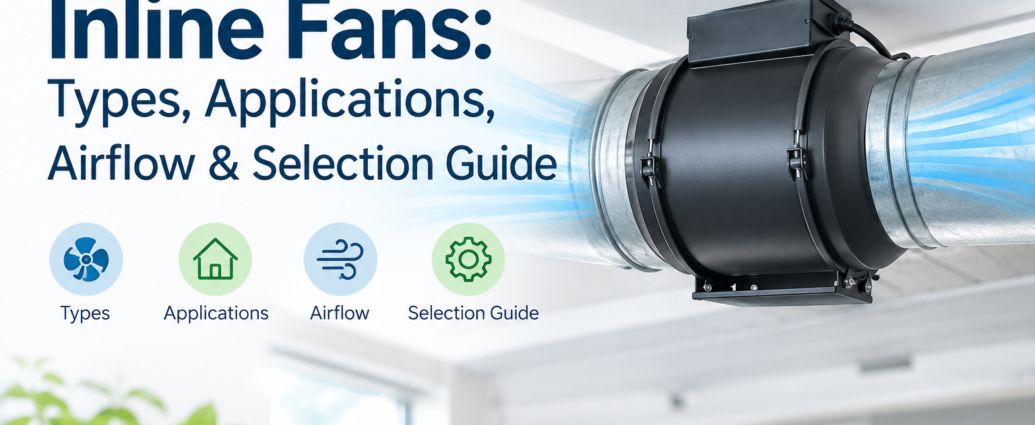
An inline fan, also known as an inline duct fan, is a type of ventilation fan that is installed inside a duct as opposed to a wall or ceiling.
The motor is located midway through the duct run – typically in an attic, under a floor, or even in a suspended ceiling – thus noise is greatly reduced within the room. Instead of acting as low-suction blowers, these powerful fans actually act as a booster, pulling air through long ducts.
Key Benefits at a Glance
Ultra-Quiet Operation: The sound of the fan is confined to the space above the ceiling as opposed to being audible within the room.
Strong Static Pressure: Distributes air throughout large spaces with long duct runs, including bends and folds.
Multi-Point Exhaust: Our Inline Fans can also pull air from multiple locations or rooms via duct splitters.
Energy Efficiency: Modern EC motors are also far more efficient at the same output and use much less power.
Types of Inline Fans
Not all inline fans are created equal. They can be generally categorized into three types of units to suit the various applications and performance levels required.
How they work: The flow of air is straight and parallel to the fan shaft.
Best for: This results in short ducts with low resistance.
1. Axial Inline Fans
Pros & Cons: Good for big airflow in simple applications but not good for long duct runs.
2. Centrifugal Inline Fans
How they work: Air enters the fan from the front. Centrifugal force throws it out of the fan at a 90-degree angle.
Best for: Long air ducts, carbon filters, and setups that restrict airflow.
Pros & Cons: The PA packs plenty of punch when it comes to air resistance, but the units are slightly larger than normal.
3. Mixed Flow Inline Fans
How they work: Axial fan airflow with the high pressure of a centrifugal fan.
Best for: They are suited to modern residential, hydroponic gardens, and commercial applications.
Pros & Cons: A compact, quiet, and very efficient fan for almost any duct configuration.
Common Uses: Where Do You Use Inline Fans?
Inline fans are very versatile and are used in many different applications, including homes, offices, and special facilities :
Commercial & Industrial Spaces: Our filters keep offices, workshops, and production rooms fresh and clean to ensure air safety.
Bathrooms & Kitchens: The ventilation system includes long hidden air ducts which quickly remove steam, moisture, and food odors to combat the growth of mold.
Indoor Farming & Grow Tents: Helps control temperature and humidity. It also brings fresh air to growing Plants.
Attic & Sub-Floor Moisture Control: Prevents dampness and timber rot by circulating fresh air under floors and into other very small spaces.z
To set up industrial-scale ventilation, it is highly recommended to check a complete airflow selection guide to choose the correct fan size in relation to the ductwork to achieve proper performance in the long run.
Understanding Airflow: CFM and Static Pressure
In order to choose a fan, you only need to know two words: CFM and Static Pressure.
What is CFM (Cubic Feet per Minute)?
This is measured in cubic feet of air per minute (CFM), which is how much air a fan can move. The amount of CFM you need in a room depends on the size of the room and the number of times an hour you want to completely change the air in a room (Air Changes per Hour or ACH).
RequiredCFM=RoomVolume(cu.ft.)DesiredACH60
Recommended Air Changes per Hour (ACH)
- Bathrooms: 8 to 10 ACH
- Commercial Kitchens: 15 to 20 ACH
- Grow Tents: 30 to 60 ACH (fresh air every 1–2 minutes)
- General Offices & Living Rooms: 4 to 6 ACH
What is Static Pressure?
Static pressure is the air resistance that air meets when traveling through ventilation system ducts, bends & filters.
- It is measured in inches of water column. Short, smooth, rigid metal pipes have low static pressure.
- Problems associated with long, flexible, ribbed ducts that contain sharp turns and filters include high static pressure.
Pro Tip: Always select a fan for the system’s static pressure and not for “free-air” CFM.
Step-by-Step Selection Guide
Use the following steps when selecting an inline fan.
1. Measure Your Space: First, determine the volume of the room in cubic feet using length x width x height in feet.
2. Calculate CFM: Use the volume from step 1 and the ACH formula above to calculate the minimum CFM required
3. Add a Buffer for Friction: Increase the design CFM by 10–20% for each 10ft of additional duct plus 10–15% for each 90° turn.
4. Pick the Motor Type (AC vs. EC):
- AC Motors: An AC Motor is less expensive to purchase up front and is easier to apply for variable-speed applications.
- EC Motors: However, an EC Motor can save up to 50% of energy, run cooler, and provide the highest precision in speed control consistently.
- 5 . Check Noise Ratings: It’s also wise to check Noise Ratings to find units with insulated fan housing or variable speed control for silent operation.
Maintenance Tips for a Longer Lifespan
Clean the Blades: Dust buildup on fan blades can decrease the efficiency of your fan and cause the fan blades to wobble, which can cause damage to your motor over time
Seal Duct Connections: Foil tape and solid clamps can be used to seal duct connections tightly so air does not leak out before it reaches the end of the duct and exits the system.
Change Filters Regularly: Clogged filters will make the motor work harder, which could shorten the motor’s life.
An investment in a good inline fan system will pay off in the long run for clean air, a dry building, and money-saving in the years to come.
Final Thoughts
When selecting an inline fan, there are several factors that must be considered in addition to the airflow of the fan. The length of ductwork, static pressure, space available, decibel level, and type of ventilation required are all you need to consider before making any decision.
Inline fans can improve airflow, control moisture and odors, and provide long-term ventilation when selected and maintained properly.
Frequently Asked Questions (FAQ)
Q: Why choose an inline fan over a standard wall or ceiling exhaust fan?
There are two primary factors when considering the installation of fans: noise and power. While wall or ceiling fans are noisily located in your living space, an inline fan is quietly located in your attic or in a duct run. In addition, inline fans are far better at moving air through long duct runs.
Q: Can I use one inline fan to exhaust multiple rooms?
Yes, by using Y- or T-splitters in your ductwork, one powerful fan can service two or even three separate rooms, and save you money in terms of the cost of additional hardware and wire for further fans.
Q: How do I know what duct size I need?
Duct sizes vary from around 4 inches up to 12 inches or more. It is generally best to ensure that the fan port is of the same size as the ducting. For high airflow (more than 300 CFM), 6-inch or 8-inch ducting keeps the airflow going smoothly without any whistling noises.
Can inline fans run continuously 24/7?
Yes, as long as the fan is rated for continuous use. Many inline fans are designed for 24/7 use in places like grow rooms, basements, and commercial spaces and come equipped with features such as sealed bearings and thermal protection.
What should I check before buying an inline fan?
Before buying a fan for ventilation, you should look for its airflow rating, static pressure, duct size, sound level, type of motor, power consumption, possibility of speed control, required installation, and its area of application.